

Contents
- First things first: what is SEO?
- So what is GEO?
- Why is everyone suddenly talking about GEO?
- Does this mean your website will get less traffic?
- What does GEO actually involve?
- So, should you stop doing SEO and focus on GEO?
- What should businesses do now?
- The no-nonsense version
- Want to know how visible you are in AI search?
SEO ain’t dead, baby…
It’s not standing still either.
Search is changing fast. But Google is still here. People are still searching. Websites still matter. Content still matters. Technical foundations still matter.
It’s just people are no longer only finding information through the classic list of blue links.
They’re asking ChatGPT. They’re reading Google’s AI Overviews. They’re getting answers from Gemini, Perplexity, Copilot and whatever new AI search tool has appeared since you started reading this sentence.
That’s where GEO comes in.
GEO stands for Generative Engine Optimisation. It is the process of improving how visible, useful and trusted your brand appears inside AI-generated answers.
In plain English: SEO helps you show up in search results. GEO helps you show up when AI tools answer the question for the user.
You now need both.
Annoying? Slightly. Important? Definitely.
First things first: what is SEO?
Excuse us while we teach Grandma to suck eggs for a moment, but SEO stands for Search Engine Optimisation.
It is the work that helps your website appear more prominently in traditional search engines such as Google and Bing.
That includes things like:
- Making sure your website can be crawled and indexed
- Writing helpful, relevant content
- Targeting the right keywords
- Improving page speed and technical performance
- Earning links and mentions from other websites
- Making sure your pages answer the things people are actually searching for
At its best, SEO is not trickery.
It is not stuffing “best dentist Wiltshire affordable emergency dentist near me” into a paragraph until everyone loses the will to live.
Good SEO is about making your website clear, useful and easy to understand – for search engines and humans.
That bit has not gone away.
In fact, if your SEO is a mess, your GEO probably will be too.
So what is GEO?
GEO stands for Generative Engine Optimisation.
It focuses on how your brand, website and content appear in AI-generated answers.
Instead of just asking, “Can we rank on page one of Google?”, GEO asks:
- Are AI tools mentioning us?
- Are they describing us accurately?
- Are they recommending us over competitors?
- Are they using our content as a source?
- Do they understand what we do, where we operate and who we help?
- Are we visible when people ask commercial or research-led questions?
That last point matters.
A user might not search “commercial electrician Bristol” any more. They might ask:
“What should I look for when choosing an electrician for a shop refit?”
Or:
“Compare using a commercial electrician vs a general electrician for a small business premises.”
Or:
“Which electricians near Bristol handle retail fit-outs and ongoing maintenance?”
Those are not always neat little keyword searches. They are conversational, messy and specific.
AI tools respond by pulling together information from multiple sources, summarising it and often naming brands directly.
That changes the game.
Not completely. But enough.
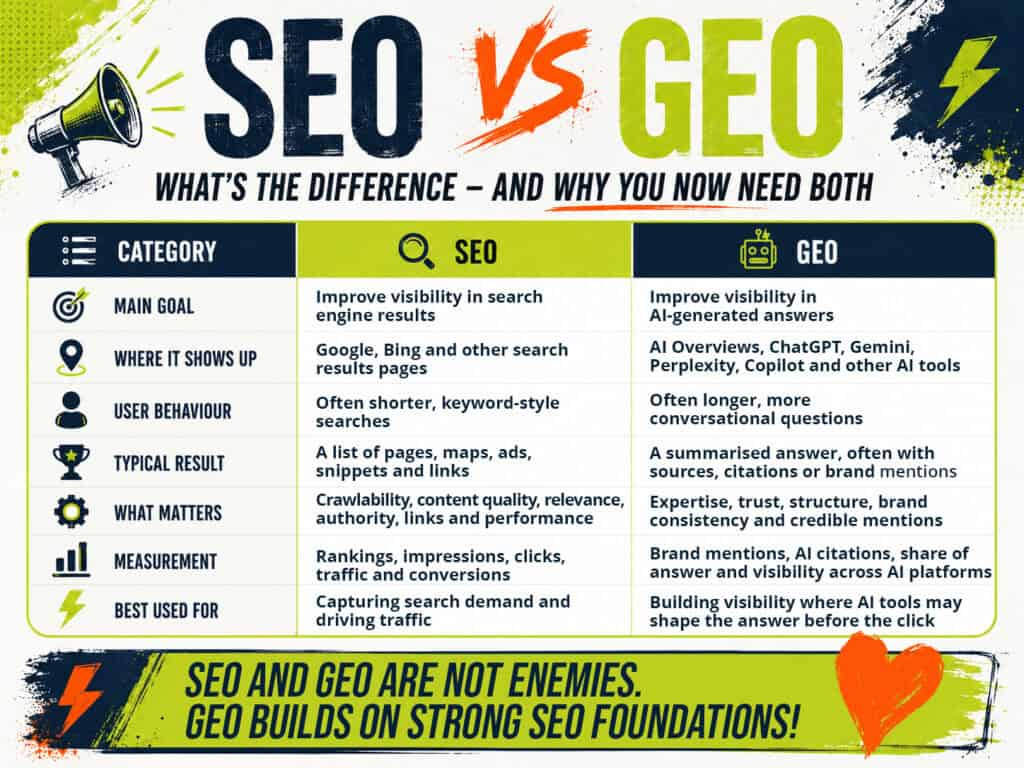
The important thing is that SEO and GEO are not enemies.
GEO does not replace SEO. It sits on top of it.
A strong website, clear content, proper technical setup and credible brand signals are still the foundation.
GEO just asks whether those signals are strong enough for AI systems to understand, trust and repeat.
Why is everyone suddenly talking about GEO?
Because AI search has moved from “interesting thing marketers talk about on LinkedIn” to “actual thing customers are using”.
And big companies have noticed.
Adobe’s acquisition of Semrush was a pretty loud signal. That was not just about traditional keyword tracking. Adobe described Semrush as part of a wider push into SEO, GEO and AI-led brand visibility.
In other words: the people with very expensive spreadsheets have decided this matters.
Google has also been clear that, from its point of view, optimising for generative AI search is still part of SEO. That is useful, because it cuts through some of the drama.
GEO is not magic. It is not a secret hack. And it is definitely not a reason to sack off your existing search strategy and start writing weird content for robots.
It is an evolution of search.
And yes, Gartner predicted that traditional search volume would drop by 25% by 2026 as AI chatbots and virtual agents take a bigger share of how people find information.
Whether that exact number lands perfectly or not, the direction of travel is obvious.
Search is becoming less about ten blue links and more about answers.

Does this mean your website will get less traffic?
Possibly.
Some informational searches may generate fewer clicks because AI tools answer the question directly. If someone asks “what does GEO mean?”, they may get enough from the AI summary and never visit a website.
That can be a problem if your strategy relies entirely on high-volume informational blogs bringing in traffic.
But it does not mean content is pointless.
It means the role of content is changing.
Your content now has to do more than attract a click. It has to help search engines and AI systems understand who you are, what you know, what you offer and why you can be trusted.
That means content needs to be clearer, better structured and more genuinely useful.
The old approach of churning out thin blogs because “we need to post something for SEO” is going to look increasingly weak.
Useful content still matters. Fluffy content has less room to hide.
What does GEO actually involve?
GEO is still an emerging area, so there is no single perfect checklist.
But the core principles are already clear.
1. Be very clear about what you do
AI tools need clarity.
That means your website should explain your services, sectors, locations and expertise in language that is specific and easy to understand.
Not:
“We deliver innovative solutions for ambitious organisations.”
Because that could mean almost anything.
Better:
“We provide commercial electrical services for shops, offices and hospitality businesses across Bristol and the South West.”
Clear beats clever when AI tools are trying to understand what you do.
Useful for search engines. Useful for humans. Not always ideal for vague straplines.
2. Build proper topic authority
One thin blog on a subject is unlikely to build much authority on its own.
A connected set of genuinely useful pages is much stronger.
For example, if you want to be visible around SEO and GEO, you might need content covering:
- What GEO means
- How GEO differs from SEO
- How AI search affects organic traffic
- How to measure AI visibility
- How to prepare your website for AI search
- What business owners should do next
That helps both humans and AI systems see that you understand the topic properly.
3. Answer real questions directly
AI tools love clear answers.
That does not mean every page needs to sound robotic. Nobody is asking you to write like a toaster with a LinkedIn account.
It means you should make life easy for the systems reading your content.
Use plain headings. Define terms. Answer the question early. Avoid hiding the useful bit in paragraph seven after a long warm-up about “the ever-changing digital landscape”.
Clear structure helps AI tools understand your content – and it usually makes things better for human readers too.
4. Strengthen your brand signals beyond your website
AI tools do not only look at your website.
They may draw on third-party mentions, directories, reviews, news articles, social profiles, industry listings and other public sources.
That means your wider online footprint matters.
Your brand should be consistent across the web. Your services should be described clearly. Your reviews should support the claims you make.
5. Use structured, well-organised content
Structure helps.
That includes:
- Clear headings
- FAQs where useful
- Comparison tables
- Concise definitions
- Schema markup
- Author information
- Dates where relevant
- Internal links between related pages
This is not glamorous work. Sadly, it is also not optional.
Messy content makes it harder for both search engines and AI tools to understand what matters.
So, should you stop doing SEO and focus on GEO?
No.
Dropping SEO because GEO is growing would be missing the point.
SEO is still the foundation.
You still need a technically sound website. You still need useful content. You still need to understand what your audience is searching for. You still need authority, trust and relevance.
GEO builds on that.
The better question is not “SEO or GEO?”
It is:
“How do we make sure our brand is visible wherever people are now searching?”
That includes traditional Google results. It includes AI Overviews. It includes ChatGPT and other answer engines.
It also includes the messy middle where users research, compare, ask follow-up questions and make decisions before they ever fill in a form.
What should businesses do now?
You do not need to panic.
You do need to prepare.
Start with the basics:
- Check whether your core service pages clearly explain what you do
- Review whether your content answers the questions customers are actually asking
- Look at how your brand appears in AI tools for relevant queries
- Make sure your business information is consistent across the web
- Build content around topics, not just isolated keywords
- Strengthen trust signals such as case studies, reviews, expertise and clear author information
- Keep measuring SEO performance, but start paying attention to AI visibility too
This is not about chasing another acronym.
It is about recognising that search behaviour has changed, and making sure your business can still be found in the places your customers are now looking.

The no-nonsense version
SEO helps people find your website through search engines.
GEO helps AI tools understand, trust and mention your brand when they generate answers.
You need SEO because Google is still a huge part of how people find businesses.
You need GEO because AI search is changing how people research, compare and make decisions.
The businesses that win will not be the ones shouting “SEO is dead” into the void.
They will be the ones quietly getting their websites, content and brand signals in order before everyone else catches up.
No panic. No jargon. No pretending the internet has not changed either.
Just a smarter search strategy for the way people actually find things now.
Want to know how visible you are in AI search?
Rebellion can help you understand where your business currently stands across SEO and GEO.
We can review how your website performs in traditional search, check how your brand appears in AI-generated answers and show you where the gaps are.
Ask us about an AI visibility check and we’ll give you the no-nonsense version. No scare tactics. No acronym soup. Just what’s working, what isn’t and what to do next.
Latest news

9 min read
30th Sep 2026
Beyond the Prospectus: Storytelling That Attracts the Right Families
Choosing a school is rarely about one thing. Facilities certainly matter, and parents will want to know about classrooms, sports pitches, theatres, boarding houses and laboratories. An impressive campus can help create confidence, but buildings alone rarely explain why one school feels right and another does not. Families are trying...

Rebellion Marketing
Read article

9 min read
21st Sep 2026
AI Search Optimisation: A Practical Guide (Minus the Mystical Nonsense)
AI search has moved the front door to your website, and nobody sent a change of address card! Someone asks ChatGPT which consultancy to shortlist, or types a question into Google and gets an AI-generated answer with three cited sources. Your brand is either in that answer or it isn’t....

Jade Arnell
Read article

9 min read
17th Sep 2026
Thought Leadership Without the Waffle: A No-Nonsense Guide for Firms
Few marketing phrases manage to sound as important and say as little as “thought leadership”. Professional services firms are routinely told they need more of it. Partners should become thought leaders. The website needs thought leadership content. LinkedIn needs a thought leadership strategy. Before long, somebody is suggesting a quarterly...
Rebellion Marketing
Read article

9 min read
9th Sep 2026
How AI Decides Which Schools to Recommend to Parents
A parent looking for a school used to begin with a fairly predictable Google search. They might type “independent schools near Oxford”, open several websites and gradually build a shortlist. Increasingly, there is another option. They can ask an AI system a much more specific question. “Which independent girls’ schools...
Rebellion Marketing
Read article